My Crown Smells Bad... A Retreatment Case with Wall Build-up
Investigating the cause of a foul odor from under a crown — secondary caries and resin core leakage treated with microscope-assisted retreatment and wall build-up. A real case from TTE Dental Clinic by Dr. Kang Seokhoon.
Patient Information
Foul odor from under crown, secondary caries
Hello, this is Dr. Kang Seokhoon, Director of TTE Dental Clinic — where we fight to save every natural tooth.
"Doctor, my crowned tooth smells bad..." Patients visit us with this complaint more often than you might think. If you brush meticulously yet still detect an unpleasant odor when you run your tongue around the crown, there is a high probability that secondary caries is progressing beneath the prosthesis.
Today, we present a case involving the lower left second molar (#37), which had received root canal treatment and a crown at another clinic 1–2 years prior. The patient noticed a persistent odor, and upon removing the crown, we discovered secondary caries and leakage beneath the resin core. Here is the full process of how we performed retreatment (Re-endo) and wall build-up to save this tooth.
Why a Gap-Free Resin Core Matters
After root canal treatment, the resin core that fills the tooth interior is not merely a space-filler. The core must form a seamless seal against the tooth walls to prevent bacterial infiltration and stop secondary caries from developing under the crown.
However, if even a microscopic gap exists between the core and the tooth, bacteria and saliva seep through — causing leakage. Over time, this leakage produces a foul odor and eventually leads to secondary caries.
Today's case is a textbook example of this scenario.
[Treatment Process]
STEP 1. Initial Assessment
The patient had received root canal treatment and a zirconia crown on the lower left second molar at another clinic 1–2 years ago. Recently, a persistent unpleasant odor around the crown prompted the visit.
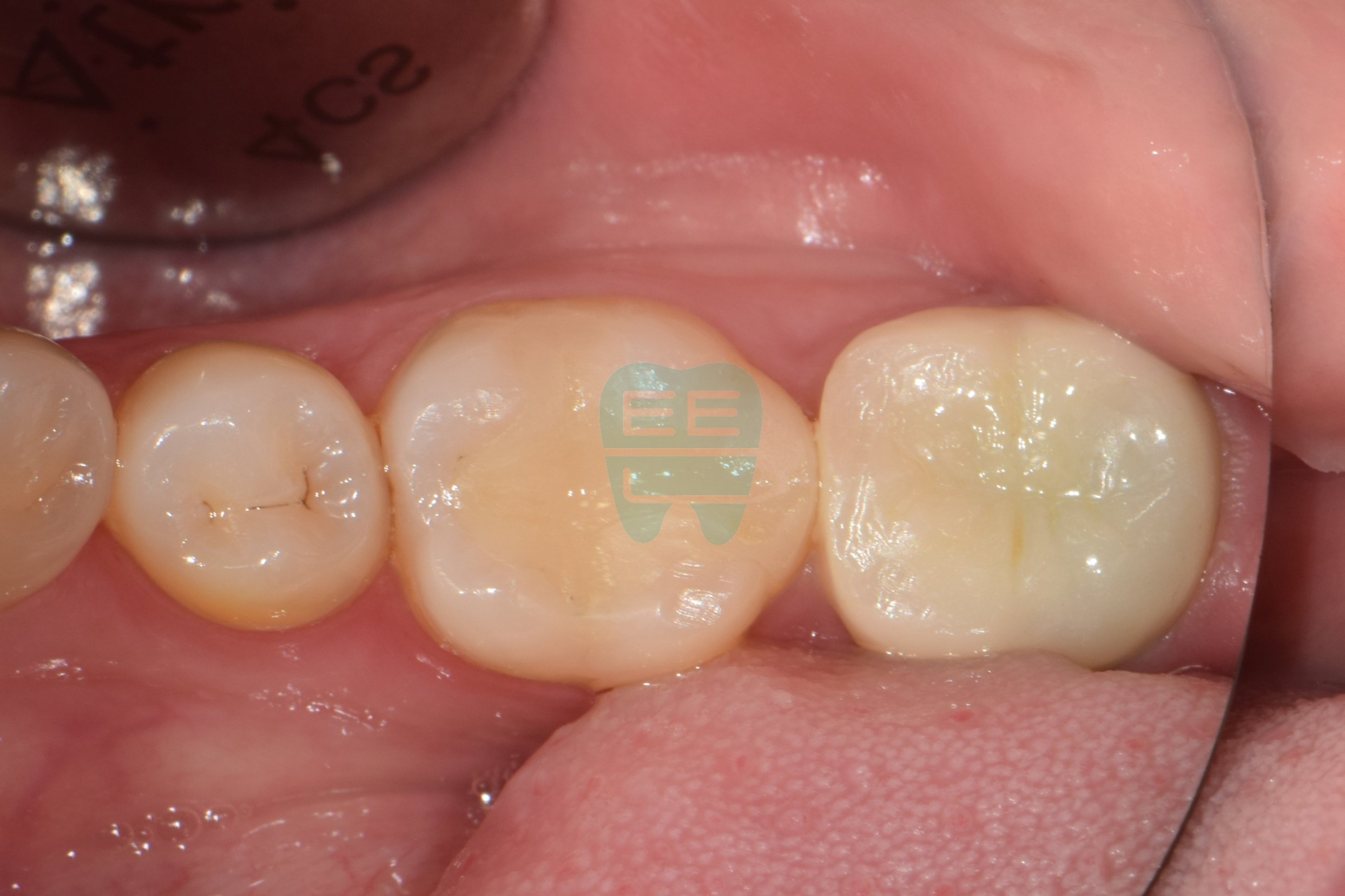
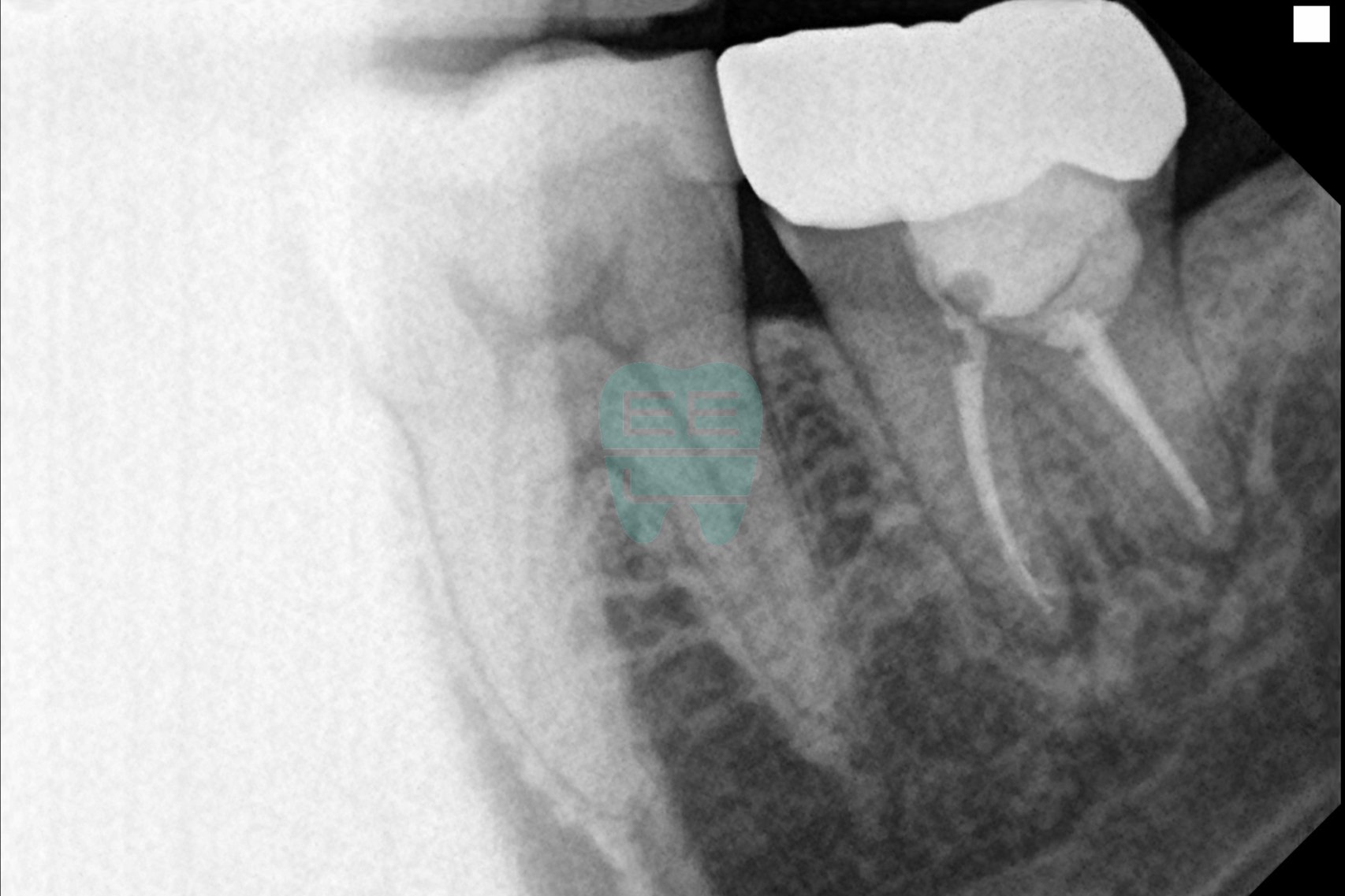
The crown appeared intact externally, but to identify the source of the odor, we decided to remove it.
STEP 2. After Zirconia Crown Removal
Upon carefully removing the crown, the problem was immediately apparent.
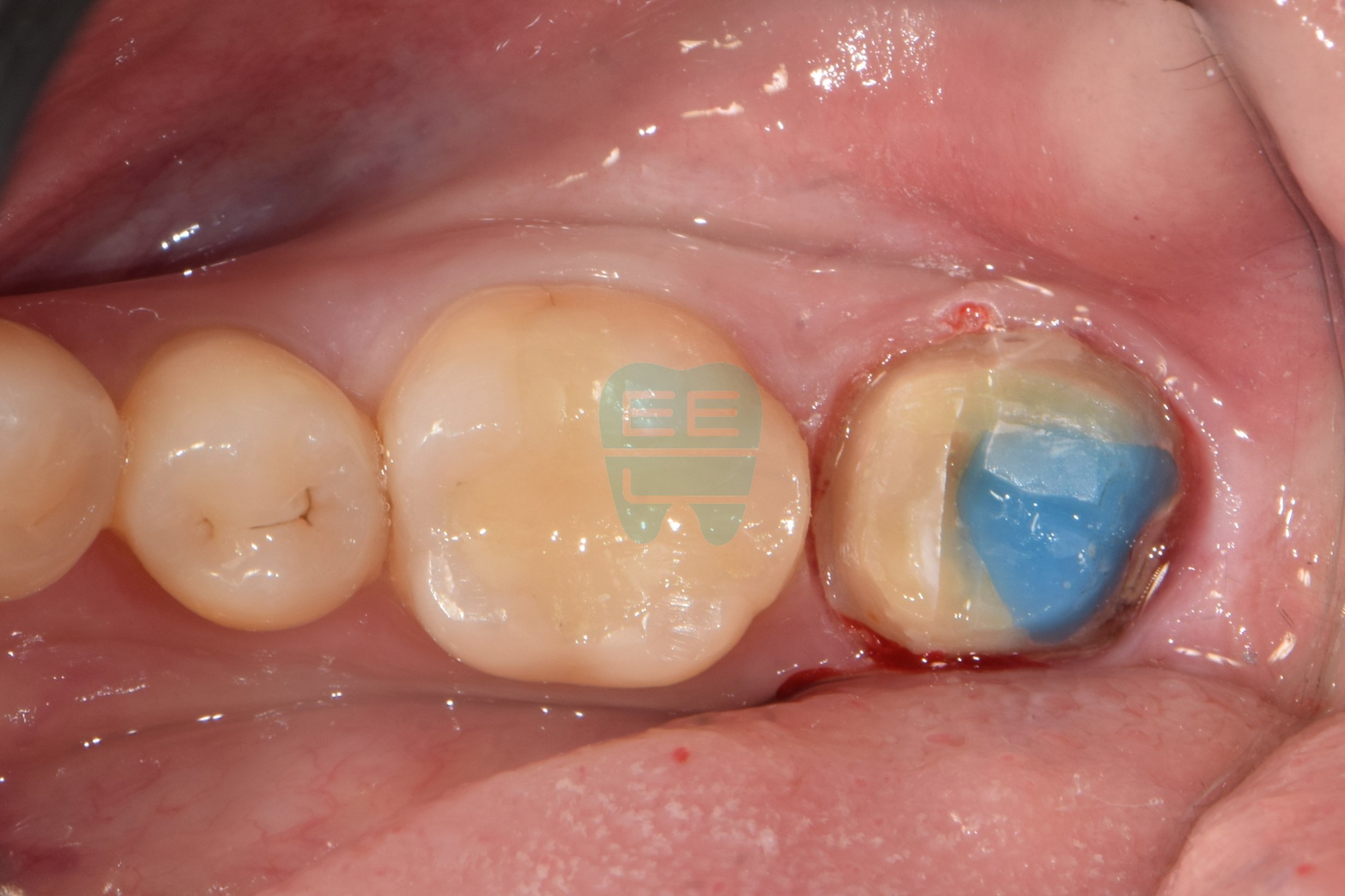
Brown discoloration from secondary caries is clearly visible along the distal surface. Leakage had occurred at the junction between the existing resin core and the tooth, allowing bacteria to infiltrate — this was the source of the odor.
STEP 3. Removing the Existing Resin Core and Caries
Now that the cause has been identified, it must be addressed at its root. The existing resin core and the distal secondary caries are precisely removed under the dental microscope.
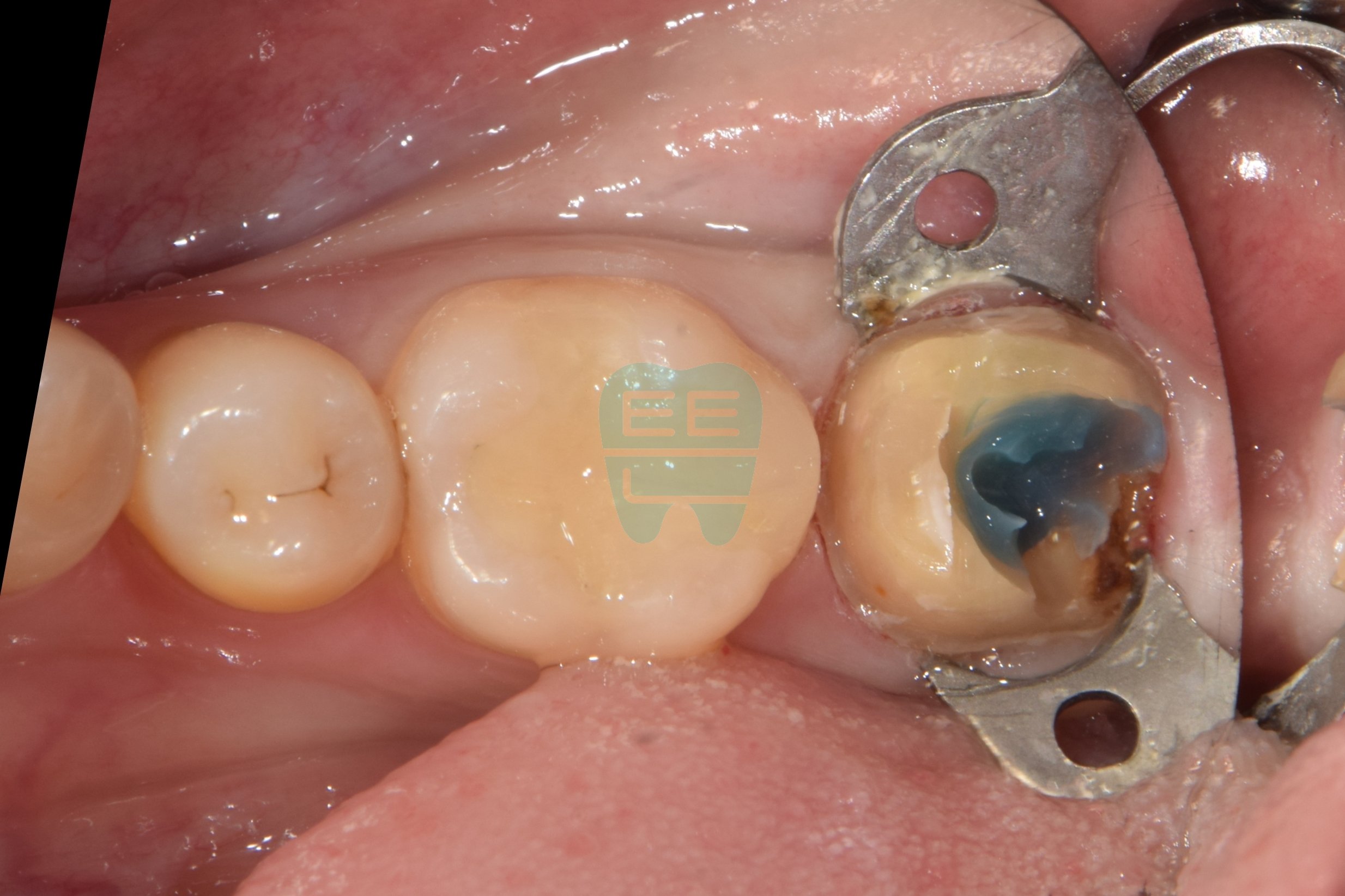
The key here is to preserve as much healthy tooth structure as possible while removing only the infected areas. This level of precision requires a dental microscope.
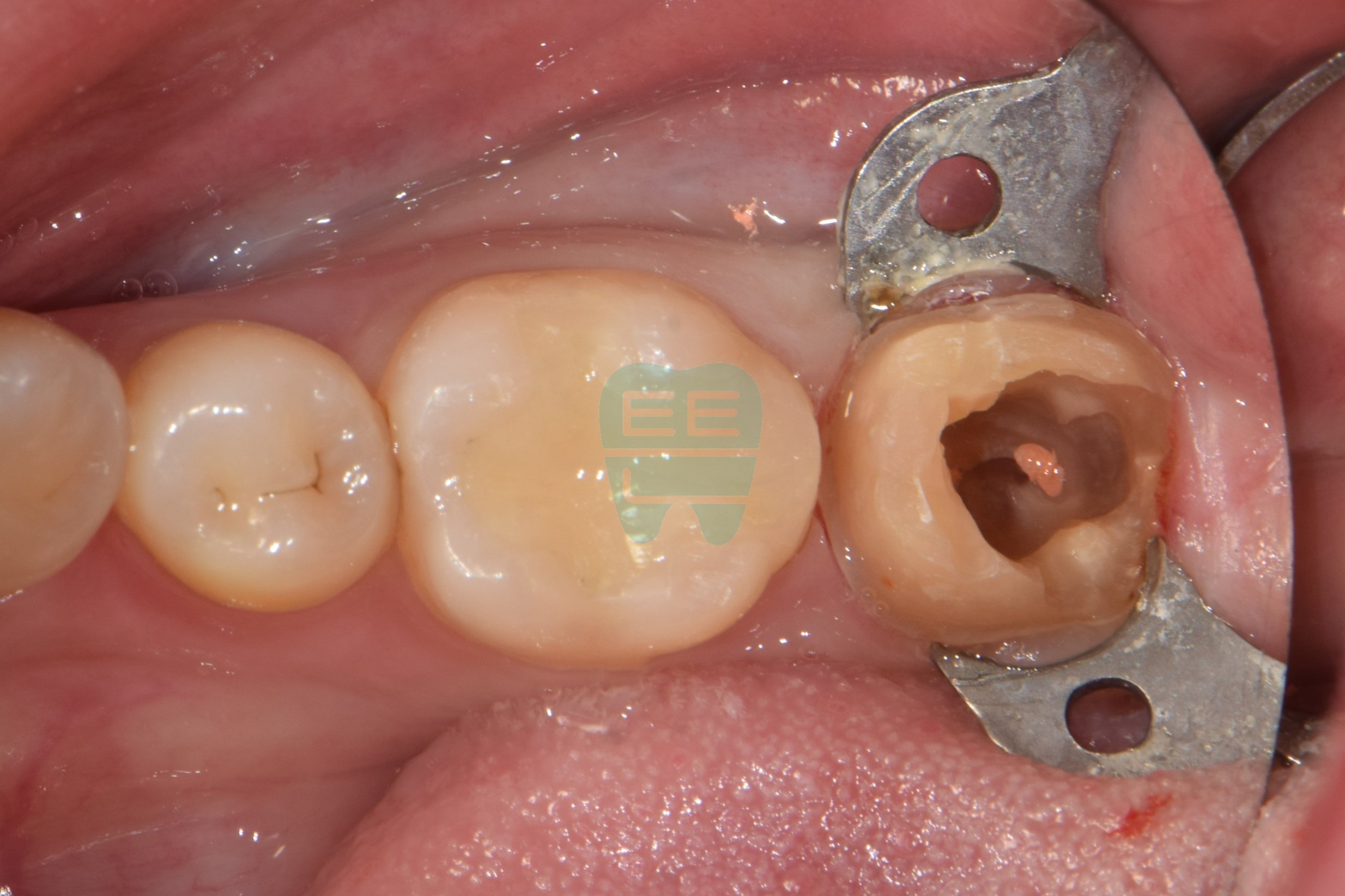
With all infected tissue and the old resin core removed, the distal wall shows significant tooth structure loss — gum tissue has grown inward. In this state, neither rubber dam isolation for retreatment nor new core placement is possible.
Key Point: This is exactly where wall build-up becomes essential. The collapsed tooth wall must be rebuilt with resin so that a rubber dam can be placed, and only with the rubber dam can retreatment proceed in a sterile environment.
STEP 4. Rubber Dam Placement and Wall Build-up
This is the most critical step for retreatment success. First, a rubber dam is placed to completely block saliva and bacteria. Then the missing distal tooth wall is meticulously rebuilt with composite resin (wall build-up) to create a sealed environment.
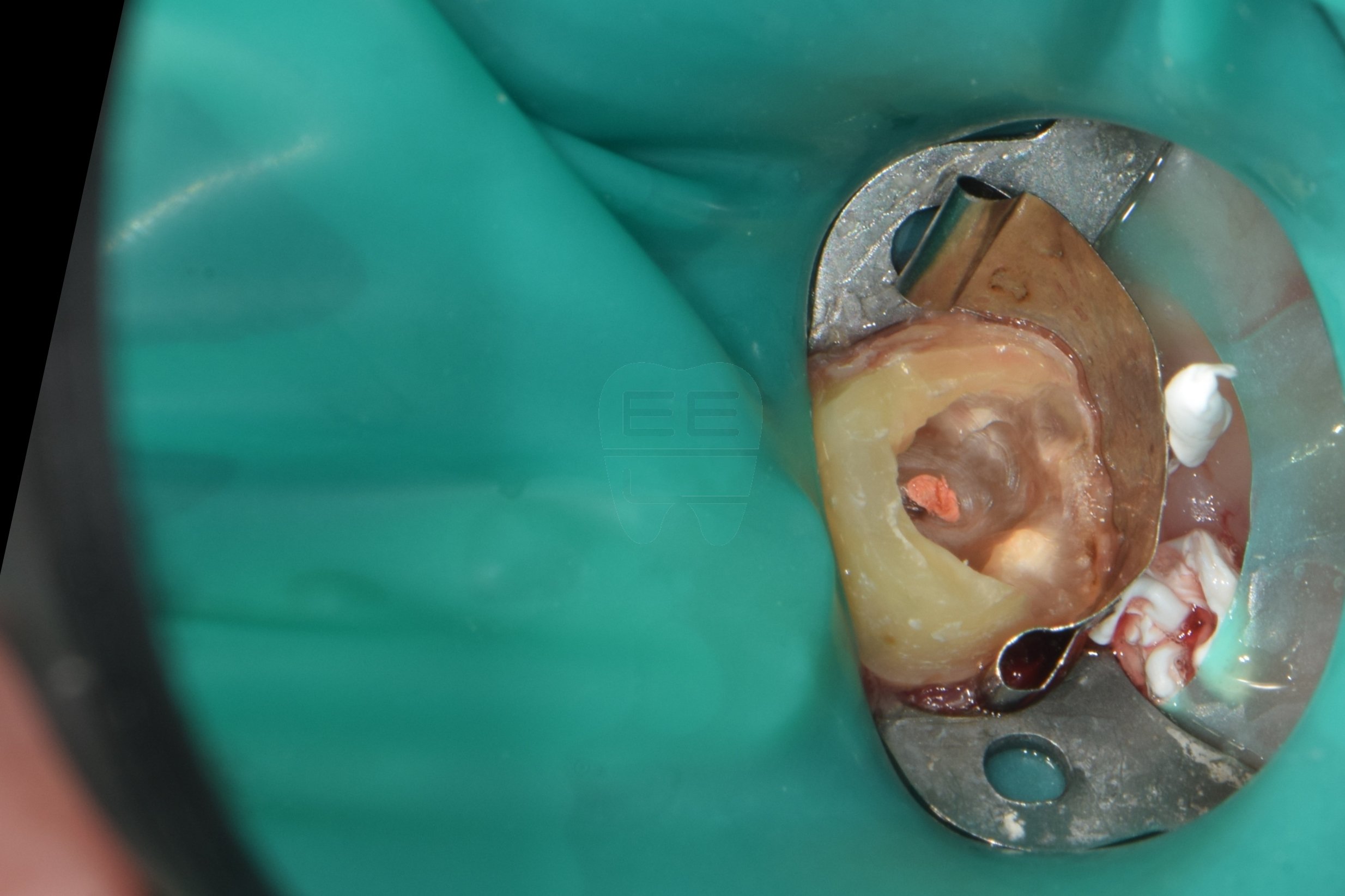
This wall build-up is the centerpiece of today's treatment. Many people think, "Can't you just do the root canal and put a crown on quickly?" But without this wall, disinfectant leaks out during treatment and saliva seeps in, leading to reinfection. The failure of the original treatment often stems from inadequate execution of this very step.
STEP 5. Wall Build-up and Resin Core Complete
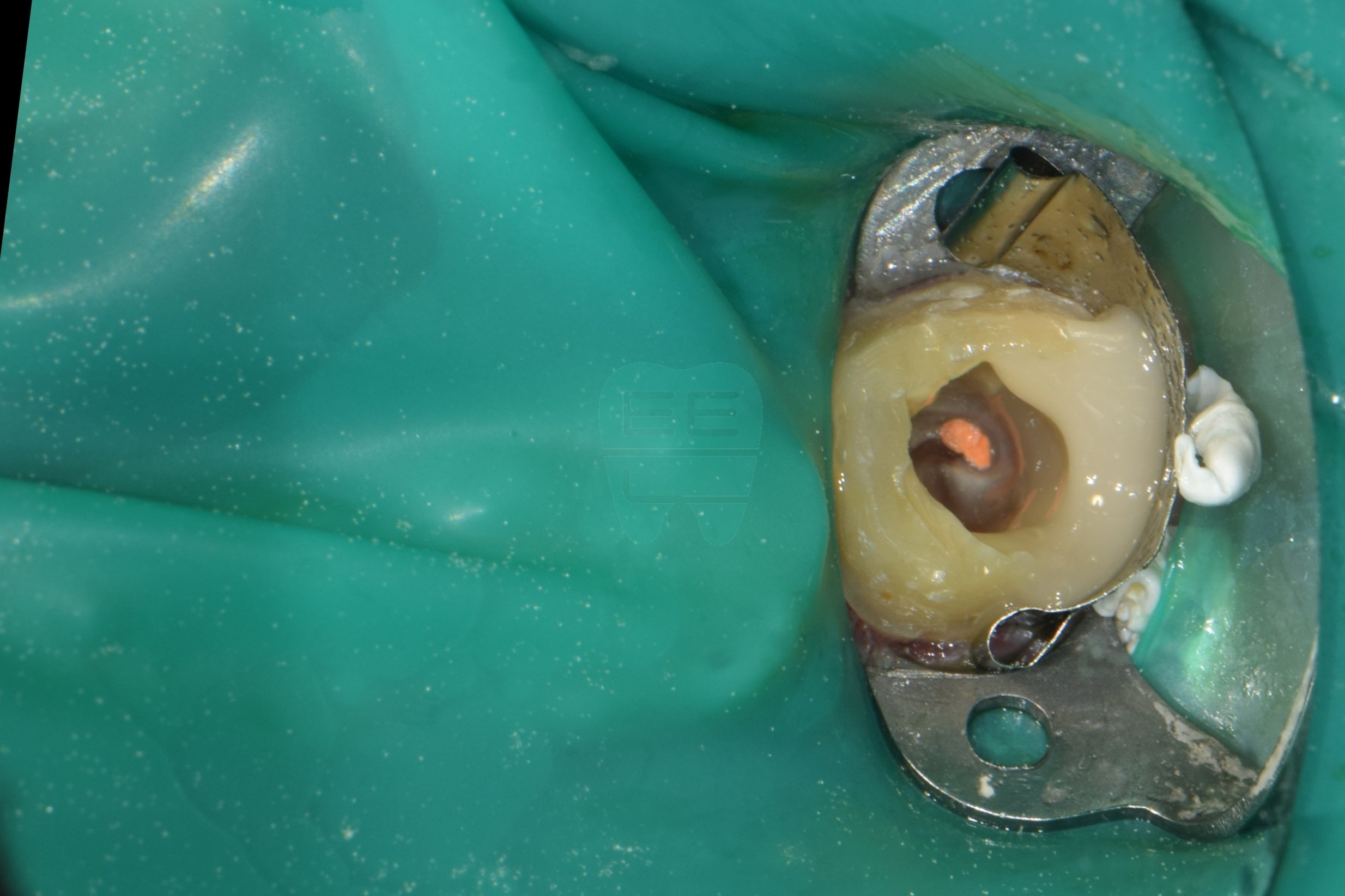
The wall build-up and resin core are complete. The collapsed distal wall has been fully reconstructed with sturdy composite resin, and the entire tooth is now sealed. Retreatment can now proceed in a bacteria-free environment.
Radiograph Comparison (Before vs. After)
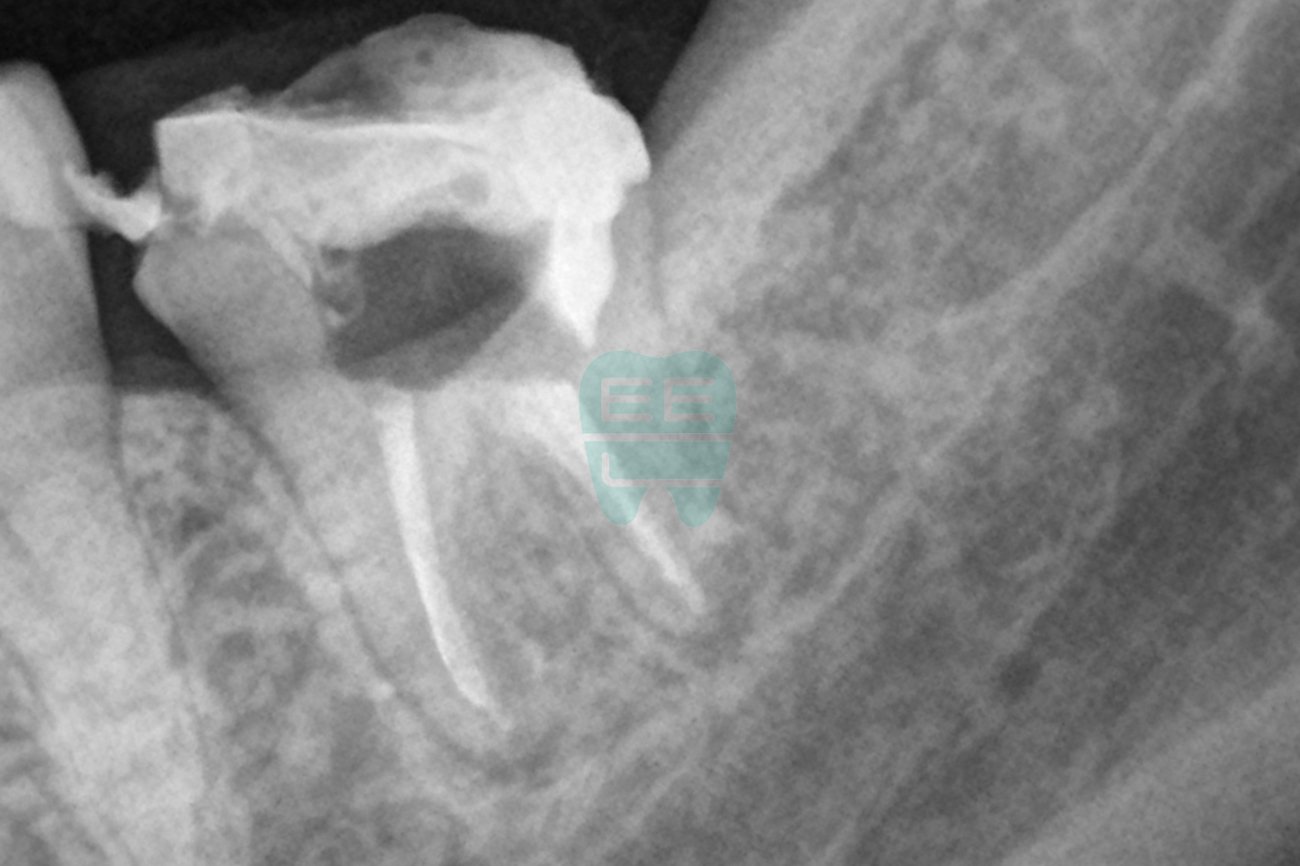
The post-treatment radiograph confirms that the previously problematic area has been thoroughly addressed. Retreatment will be finalized and a new crown fabricated for definitive restoration.
Why Is Retreatment More Difficult Than Initial Treatment?
Retreatment (Re-endo) is significantly more challenging than first-time root canal therapy. Here is why:
- Removing existing filling materials: The old root canal filling must be completely removed, with risk of root damage during the process.
- Secondary caries management: The tooth has already been treated once and decayed again, leaving less healthy tooth structure to work with.
- Wall build-up required: Tooth walls are often missing, necessitating additional wall construction for rubber dam isolation.
- Microscope essential: High-magnification microscopy is indispensable for locating hidden canals and removing infected tissue invisible to the naked eye.
For these reasons, retreatment should be performed at a clinic equipped with a dental microscope and extensive clinical experience.
If Your Crown Smells Bad, Do Not Ignore It
A foul odor from a crown is not simply a bad breath issue. It is a warning sign that secondary caries is progressing beneath the prosthesis. Left untreated, the decay can spread to the root tip and ultimately require extraction.
However, as today's case demonstrates, when caught in time and treated with proper retreatment and wall build-up protocols, the natural tooth can absolutely be saved.
"A gap-free resin core determines the lifespan of your tooth." At TTE Dental Clinic, even when it takes more time and effort, we use the dental microscope to deliver meticulous, gap-free treatment to protect your precious natural teeth.
Disclaimer
All clinical photographs were taken with the patient's consent under standardized conditions. Treatment outcomes may vary by individual, and complications may occur.
임상 사진
(8장)관련 증례
Same Cavity, Different Outcomes — How Dental Microscopes Transform Every Treatment
Minimally Invasive Resin Build-up Is the Answer for Pediatric Cavities — Treating Extensive Secondary Caries in a 9-Year-Old