AquaCare: Scientific Evidence for Enhanced Bond Strength — 2025 International Research Review
A review of the 2025 international study (J Esthet Restor Dent) showing that AquaCare's AquaSol wet-spray technology improves dental bond strength by up to 21%.
Patient Information
Research Review
Academic
AquaCare bond strength enhancement — international research evidence
Introduction
The long-term success of resin restorations (resin build-ups, inlays, crown bonding, etc.) depends heavily on the bond strength between the tooth and the adhesive. No matter how precisely a restoration is fabricated, weak adhesion can lead to debonding or microleakage over time, eventually resulting in secondary caries.
Dentin is particularly challenging for stable adhesion compared to enamel, due to its higher moisture and organic content. Therefore, how the dentin surface is treated before bonding is a critical factor that determines the longevity of the restoration.
AquaCare is an air abrasion device that treats tooth surfaces by projecting fine powder with high-pressure air. Its AquaSol feature delivers simultaneous irrigation during powder application, removing residual particles in real time and creating a clean bonding surface.
So, is there scientific evidence that AquaCare actually improves bond strength? Let us examine the findings from an international research paper published in 2025.
Study Overview
Referenced Paper
Falacho RI, Almeida G, Naupari-Villasante R, et al. "Effect of Different Airborne-Particle Abrasion Strategies on Dentin Bond Strength: An In Vitro Study." J Esthet Restor Dent. 2026;38:173-184.
- Publisher: Wiley (international SCI-level journal)
- Peer-reviewed publication
- Research institutions: University of Pennsylvania, University of Coimbra, and others (international collaborative research)
This study systematically compared how different air abrasion methods affect dentin bond strength. In particular, it scientifically evaluated how AquaCare's AquaSol wet-spray function impacts adhesion.
Experimental Methods
Specimen Preparation
- 20 human molars were used
- Dentin surfaces were exposed, then 4 different surface treatment methods were applied
Four Surface Treatment Groups
- Control — No surface treatment
- Al2O3 without irrigation — Aluminum oxide spray without water (dry air abrasion)
- Al2O3 with irrigation (AquaCare + AquaSol) — Aluminum oxide spray with simultaneous water delivery — key experimental group
- Bioactive glass 45S5 — Bioactive glass powder spray
Adhesive Systems
Two adhesive types were applied to each group for comparison:
- Clearfil SE Bond (self-etch adhesive)
- OptiBond FL (etch-and-rinse adhesive)
Evaluation Methods
- Microtensile Bond Strength (uTBS) measurement — the international standard for evaluating bond strength
- Scanning Electron Microscopy (SEM) analysis — observation of surface conditions and fracture patterns
Key Results
Bond Strength Comparison
The AquaCare + AquaSol group (Al2O3 with irrigation) recorded the highest bond strength across all adhesive types.
Self-etch adhesive (Clearfil SE Bond) results:
- AquaCare group: 59.1 MPa
- Control group: 51.7 MPa
- Approximately 14% improvement (p < 0.001)
Etch-and-rinse adhesive (OptiBond FL) results:
- AquaCare group: 41.0 MPa
- Control group: 33.9 MPa
- Approximately 21% improvement (p < 0.001)
p < 0.001 indicates a highly statistically significant difference. In other words, AquaCare's bond strength enhancement is a scientifically proven result, not a coincidence.
Comparison with Other Groups
- The AquaCare group showed statistically significantly higher bond strength compared to the control group, dry air abrasion group, and bioactive glass group (p < 0.001).
- Even when using the same aluminum oxide powder, the presence or absence of water delivery made a decisive difference in results.
SEM (Scanning Electron Microscopy) Analysis
- AquaCare group: Cleaner dentin surface, open dentin tubules, significantly fewer residual particles (debris)
- Dry air abrasion group: Residual aluminum oxide particles remained on the surface, impeding adhesive penetration
Failure Mode
- The AquaCare group had the highest rate of cohesive failure
- This means the material itself fractured before the adhesive interface, indicating that the bond was exceptionally strong.
Clinical Significance
Summarizing the findings of this study, the following clinical implications can be drawn:
1. AquaSol wet-spray is the key
The critical mechanism for improving bond strength is not simply performing air abrasion, but delivering water simultaneously during spray to remove residual particles. AquaCare's AquaSol feature serves precisely this function.
2. Clean surface = Strong bond
As confirmed by SEM analysis, when residual particles on the dentin surface are removed through wet-spray, the adhesive can penetrate deeper into the dentin tubules. This translates directly into a stronger, more stable bond.
3. Limitations of dry air abrasion
Spraying powder without water delivery can leave residual particles on the surface, potentially interfering with adhesion. This study clearly demonstrates the importance of wet-spray technology.
4. Contribution to long-term restoration survival
Higher bond strength improves the long-term stability of restorations. Surface treatment with AquaCare can enhance outcomes across various restorative procedures, including resin build-ups, inlays, and crown bonding.
AquaCare Utilization at TTE Dental Clinic
Based on this scientific evidence, TTE Dental Clinic actively incorporates AquaCare into all adhesive restorative procedures.
Applications in Daily Practice
- Before resin build-up: After caries removal, the dentin surface is treated with AquaCare to create an optimal bonding environment.
- Before inlay/onlay bonding: The cavity interior is pre-treated with AquaCare to maximize bond strength.
- Before crown cementation: The abutment surface is thoroughly cleaned to ensure long-term retention.
- During old restoration replacement: Residual adhesive or cement is effectively removed.
Combined Use with Dental Microscope
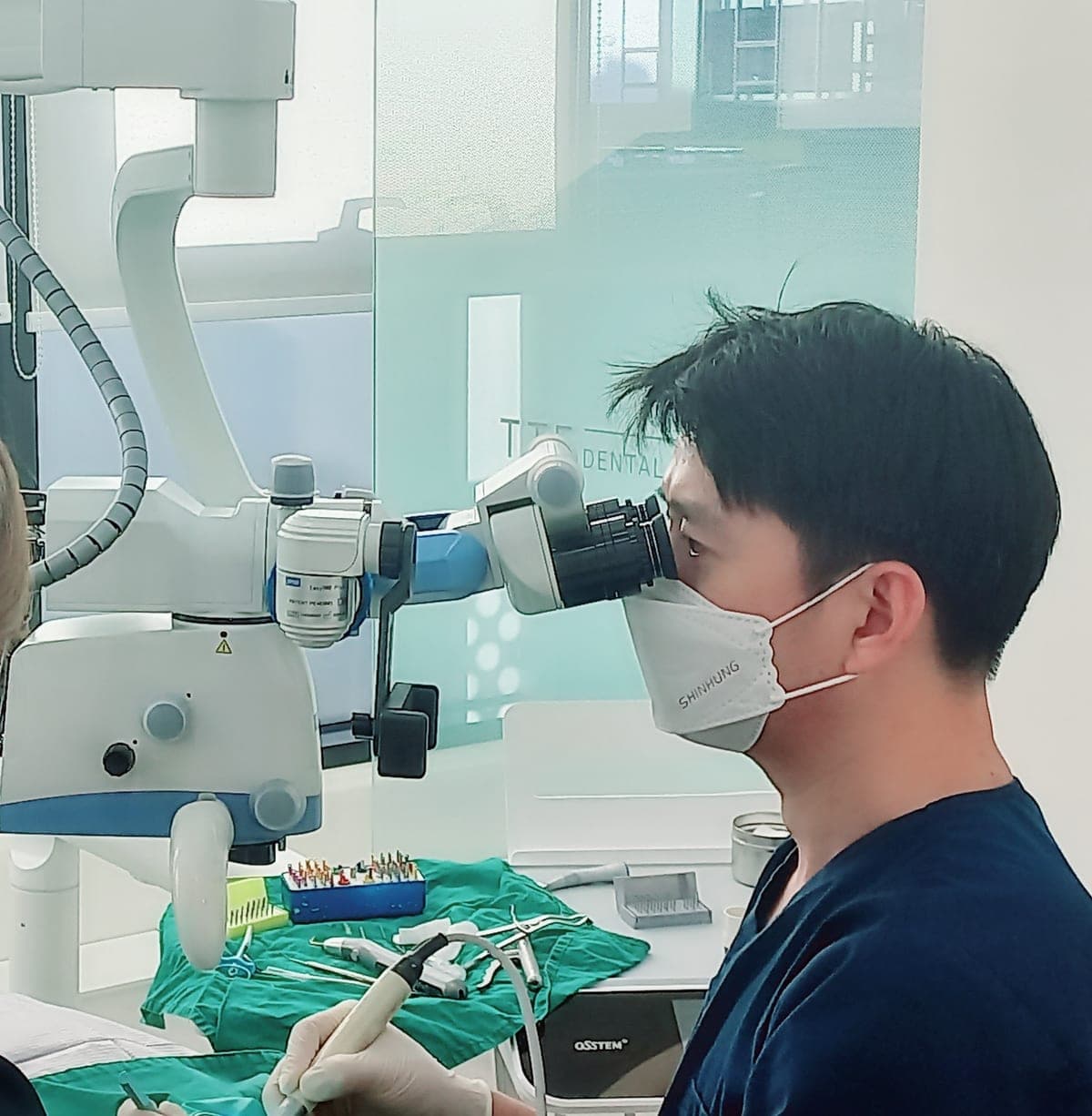
AquaCare is used under the dental microscope (x12.5-x25 magnification), allowing direct visual confirmation of the bonding surface condition during treatment. Microscopic residual particles invisible to the naked eye can be identified and removed, enabling even more precise adhesion.
Patient Comfort
- Minimal vibration: Significantly less vibration compared to conventional high-speed handpieces.
- Low heat generation: Wet-spray technology minimizes heat generation during the procedure.
- Reduced discomfort: In many cases, the procedure can be performed comfortably without anesthesia.
AquaCare feels like a gentle water spray to patients, making the procedure much more comfortable for those who are anxious about conventional drill (handpiece) treatments.
Conclusion
This paper published in the 2025 Journal of Esthetic and Restorative Dentistry scientifically demonstrates that AquaCare's AquaSol wet-spray technology significantly improves dentin bond strength in a statistically meaningful way.
To summarize the key findings:
- 14% bond strength improvement with self-etch adhesive
- 21% bond strength improvement with etch-and-rinse adhesive
- Statistically significant difference compared to all comparison groups (p < 0.001)
- Cleanest dentin surface confirmed by SEM analysis
TTE Dental Clinic utilizes AquaCare based on this scientific evidence and continues to review the latest research and technologies to practice evidence-based dentistry.
If you have any questions about dental restorative treatment, please feel free to contact TTE Dental Clinic.
관련 증례
Same Cavity, Different Outcomes — How Dental Microscopes Transform Every Treatment
Minimally Invasive Resin Build-up Is the Answer for Pediatric Cavities — Treating Extensive Secondary Caries in a 9-Year-Old